Sylvan - a case study
Motivation to learn French in class and abroad

Having taken the time to write a few blogs at best tangentially related to my research, I wanted to return to it. I had been thinking on and off about paper I wrote a number of years ago, with a plan to return to it for publication. Life took over though and this was left fallow, as presented below.
This is a case study of a boy I called Sylvan, who studied French in high school and went on exchange between year 11 and 12 to France. This case study is an illustration of the way in which language motivation derives from experiences both directly and indirectly related to language learning. What fascinated me most in Sylvan’s trajectory and his stories, were how he made sense of his personal experiences through those of significant people in his life. I hope you enjoy Sylvan’s story, then, and that what follow provides you with a window into your own students’ motivation to learn a language.
1. Introduction
In Australia approximatively 1500 high school students participate in an exchange program provided by a registered association. While extensive and accurate data is collected from tertiary students participating in study abroad experiences, very little is known about secondary school students’ experience. This lack of information has the consequence of leaving students, parents and teachers in the dark as to how to prepare for such a trip and how to support returnees.
This paper traces the language learning journey of 17 year old Sylvan (pseudonym), a year 12 student of an Anglican school in Canberra. Following a retrospective interview in April 2015, Sylvan and I kept a correspondence, which lasted 8 months. The content of this email exchange had three purposes: to clarify aspects of the data collected at the interview, to involve Sylvan in my understanding of his words, and to keep updated about Sylvan’s experiences in his final year of high school.
A conversation Sylvan and I had later on at a cafe in Melbourne also contributed to the data below and my interpretation of his learning and motivational trajectory. Sylvan gave his consent for me to use this data, and he also reviewed and commented on this paper. This work is thus both his and my work, and I consider it a co-authorship.
For the sake of this blog, I am not including here a review of the study abroad literature, nor the details of the methodology. I understand that methodology is an important section to understand the framework a researcher used to interpret the data, and if any reader is interested, I am happy to provide this section by email. I might even write a short blog about it at some point if you are able to wait until then (I know such a blog would sound entirely riveting).
The questions that drove this study were:
- What happened during Sylvan’s language learning journey in formal classes and in France?
- What is the impact of this language learning journey on Sylvan’s motivation to learn French?
5. Sylvan
Sylvan’s social world, like most teenagers’, revolves around family and school life. These are essential loci of Sylvan’s identity formation and are the very ones in the SA context that facilitated an identity shift in a period of time as short as 10 weeks.
Sylvan was born in South Africa from an Anglican minister and his medical doctor wife. He has a brother, younger by two years. When he was 6 years old, Sylvan and his family moved to Australia where the family still currently reside. In his family, Afrikaans and English are both spoken fluently.
Sylvan attended a government school in his early years of schooling, but then joined an Anglican school for the remainder of his pre-university years.
5.1 Pre-departure narrative
To understand Sylvan’s journey as a language learner, his family and school context offer a starting point from which it is possible to observe the emergence of an L2 motivation as a system.
5.1.1 Family
Sylvan’s relationship with his father was a key to understanding Sylvan’s motivation as a language learner. Numerous times during the interview, Sylvan expressed his admiration for his father. Sylvan’s father was indeed very accomplished academically and held an important position in his community as the minister of the local Anglican church.
Explaining how he had developed a wish to go to France on exchange, Sylvan chose to relate the following anecdote about his father’s experience as an exchange student in Austria.
[1] He talked about how he went on the train and he was in the carriage with a woman who couldn't speak English and he could speak some German so the only language they had in common was German. And he was forced to use what he knew. He talked about how it had been useful for him as someone who was learning another language. And the only way and the best way to really learn a language is by truly immersing yourself in that country where you’re isolated from the English speaking world.
The connection between the event and the final statement is based on the father’s experience, but is couched in the unequivocal adverbs “only”, “really”, and “truly”. The transition between the events told in the past tense and the concluding comment in the present tense also reinforced the statement’s truthfulness.
While the narrative structure is unremarkable, it did nevertheless occur to me that the final statement is the concluding remark to an experience Sylvan did not have. Sylvan’s sense of reality was based on his father’s experience.
Sylvan’s imagination was fed by his father’s experience. He was attracted by the adventure the program would offer, and the challenges that would come with it. On the other hand, the story also provides an insight into how the dynamics of Sylvan’s relationship with his father played a role in his decision to participate in an exchange program.
5.1.2 Language classes
… polite and pleasant… He has applied himself in class and has worked well.
Year 7, Semester 2 report
[Sylvan] is a quiet, conscientious and mature young man who has made commendable progress in all facets of his study of French this semester. Year 8, Semester 2 report
[Sylvan] is a mature and polite young man. He works consistently well and independently of teacher instruction. Year 9, Semester 2 report
These are just some of the comments written by Sylvan’s teachers. In each report, the first part of the comment focuses on their perceived vision of Sylvan’s character and is followed by their assessment of his work or progress in the language class. Teachers appear to make an implicit connection between Sylvan’s personality features and his achievement in French classes. While Sylvan is consistently described as a motivated student, these reports also paint the picture of a fairly introverted young teenager. Indeed as well as the above praises, Sylvan is also asked to “participate fully in class activities” (Year 9, semester 2 report).
Sylvan’s behaviour in class, both motivated and quiet, and hard-working but needing to participate more, may be explained in some measure when compared with his assessment of teachers.
[2] S: At my school we went through the first two or three years a lot of teachers. There weren’t that many good quality teachers. […] My first French teacher was a man whose mother was from Mauritius […] I wouldn't say he was an effective teacher. [...] his way of teaching wasn't very effective in that he was easily distracted by students.
In year 8 I changed teachers. […] She was a significant improvement. That was a good year for me. She was good at making you feel motivated [...]. . And then there was the other class you had to the Mauritian Chinese teacher. And he left halfway through the year. And then my teacher who was head of language at my school she couldn't find a replacement but there were two staff members in the school who knew how to speak French, they didn't really know how to teach it but they could speak French. So they were put in charge of the lessons. It was a pretty big failure on [the school’s] part. The only thing I heard about those classes were the exploits from the students and nothing about the learning of French. So I think that's why 70 percent of the kids decided not to go on with French in year 9.
Sylvan’s full description of his French classes also highlighted issues including large drop out numbers, class chaos, lack of teaching abilities, tensions between staff, mid-year departures and inadequate replacements. This picture of challenging classes goes some way in explaining how even a motivated student is reluctant to participate fully in learning activities.
In the light of the issues Sylvan noted, the connection between character and language ability in the school report can be interpreted as a consequence of the challenges language teachers faced in their classes. Sylvan was making progress in French because he was behaving in class, whereas those who didn’t were not progressing. Thus, language progress results from good character.
5.1.3 The guidance of an inspirational teacher
It was nevertheless in the chaotic environment he described that Sylvan found guidance. The narrative of the following story, just as previous quotes, contains a structure that reveals the complexity of Sylvan’s motives.
[3] She always talked about how her… the time she’s been in France as a learner was influential on her learning. […] She said she also went to Montreal in Canada for few years. The French there is also different I know […], but she cited personal examples about how it influenced her learning.
She said also that the students she had, how their grades, and specifically how they went on the oral part, which, in year 11 and 12 in my school is usually an interview – it depends on the topic so the one I had a few weeks ago was a job interview. […] And she said their performance specifically on those task I mean as well as on others they improved a lot as well.
But fact to me that the speaking improved so much that was also an important factor for me because obviously when you learn a language you learn to speak and communicate with other people. So the fact that that is going to improve so much through an exchange was also very appealing I guess.
This quote is a good summary of Sylvan’s teacher motivating him to participate in a study abroad program. Adventure was again promised but also the linguistic improvement and long with it the better grades in the final two years of high school were key to Sylvan’s decision.
This anecdote is paragraphed into its three narrative sections. The first paragraph begins with the teacher as a person and her experience as a language learner and exchange student. This is followed by comments on how the exchange improved this teacher’s past students’ academic performance in speaking as well as in other linguistic areas. Finally, Sylvan concludes on a remark that makes the connection between a greater mark in the oral assessment and the ability to hold a genuine conversation in the target language.
Similarly to the concluding remark in the father’s anecdote in Austria, Sylvan again ends this narrative with a strong statement of truth.
From the interview data, Sylvan’s father and French teacher appear as strong motivators to learn French. Importantly, they also offer a means to achieve his linguistic aspirations, going to France.
The following table summarises Sylvan’s pre-departure motivational profile for going on exchange and learn French.
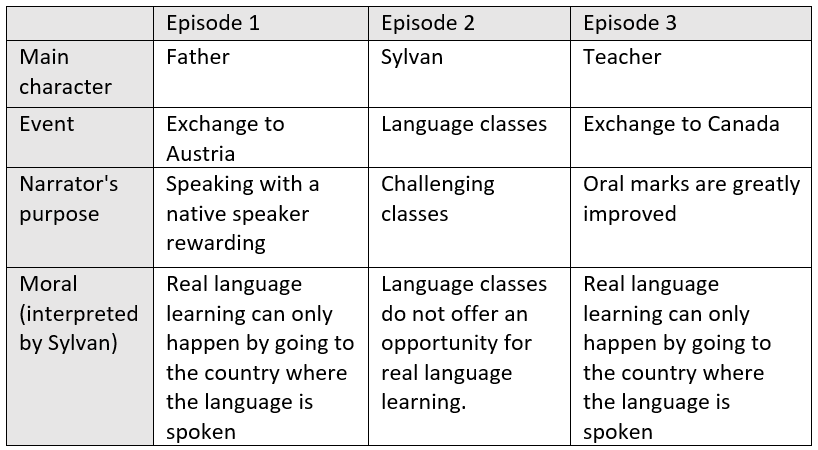
Table 1. Pre-departure episodes comparative table
5.2 Experience abroad
An important distinction between pre-departure narrative episodes and Study Abroad episodes is the exclusive focus on personal experience. For obvious reasons, Sylvan is unable to refer to narratives of others because once he left Australia, he was creating meaning through his own experiences. The narrative episodes’ structure is therefore very different – we are no longer witnessing Sylvan’s interpretation of other people’s words, but rather his interpretation of lived experience.
The nature of these episodes are consequently quite different. Sylvan doesn’t believe in his own infallibility, as he does to some degree his father’s. Morals and truths are conspicuously absent from these episodes. This narrative shift reflects the identity shift that Sylvan experiences.
5.2.1 Host school – classes, teachers and friendships
On his first day of school, Sylvan attended his host sister’s class rather than the one he was assigned to. The following passage mark a gradual negotiation into a status as a class member and a friend.
Sylvan’s position developed within the classrooms along with his linguistic abilities. At the very beginning, Sylvan was not expected to participate and possibly was seen as an extra burden on the teachers. Narrative episodes [4] and [5] contrast Sylvan’s role at the start of his exchange and later on. [4] for example, begins with Sylvan’s statement that the teacher did not want to invest into him, perhaps because he was focused on the content of his lesson and the purpose of his class session.
[4] The teacher didn't really look interested in me. He was definitely focused on teaching the class.
[My host sister] explained that I was here because my class hadn't started yet. And I was quite tired so I guess I zoned in and out of the class. And because it was biology they were using quite technical vocabulary but because I took biology in school and that the technical vocabulary is similar in French and English.
But anyway it was quite challenging.
This passage can be seen as Sylvan’s realisation that he has no recognisable identity or position in the class. Until Sylvan is able to negotiate it with the teachers and students, he is nothing more than the host family’s visitor. This episode ends with Sylvan’s assessment of the situation, focusing on the “challenging” aspect of the early classes’ experience.
In the next passage, Sylvan describes how his position in the class was negotiated successfully.
[5]’s structure starts similarly to [4]. Sylvan makes a general statement about the teacher’s attitude towards him. The narrative episode brings to light a more positive aspect of the experience. This positivity is only the more striking by the fact that it happens in a French class.
[5] The teacher tried to include me more.
She asked me to read sometimes. She was quite happy with the way I read. The first time I read I remember she was so happy with the way I read that she made me continue reading. And then sometimes she got me to write about the novel they were studying which was ‘Rhinocéros’, but it wasn't something easy for me, or something I followed very well, but she [made] French something about Shakespeare [for me].
As Sylvan’s exchange progressed, he negotiated his student status with this teacher, something he had done in his Australian high school. In this French class, his foreignness was appreciated by the teacher and he was invited to contribute by reading out loud a portion of the play Rhinocéros. This passage shows not only that the teacher was finding ways for Sylvan to participate and assess his level of French, but also that she was adapting her expectations to his particular situation. Finally, she went so far as to changing her curriculum in order to accommodate Sylvan’s area of expertise. Sylvan’s status consolidated thanks to this teacher’s consideration. She engaged him meaningfully in her classes, allowing Sylvan to feel included. This inclusion, however, wasn’t entirely pervasive. [6] illustrates how Sylvan’s status was continually contested and negotiated, principally due to language barrier.
[6] Usually I would get a copy of the test.
They would ask me if I wanted a copy and every time I said yes. Especially with math, just so I could have some comparison. Whenever I didn't do the test it was because there was specific vocabulary I didn't know. I would read the question and understand it but I would not know what the answer was.
On one of the test which was the Bac Blanc [practice final examination] in French it was a 3 hour essay. I went to the library and borrowed some books.
Nevertheless, this passage also shows that Sylvan was developing skills to assert himself more strongly, as he would always accept the tests.
Teachers played a crucial role in Sylvan’s feeling of inclusion, but of course were not the only, or the most important, channel for his admittance in the school.
Friendships were essential to be made if Sylvan was ever going to feel accepted. It is perhaps not surprising that Sylvan observed the social organisation of his peers and tried to befriend different groups, remaining open to others.
[7] Me: Would you say that you were more part of the group or that you had individual friendships?
S: I guess in a way you could say that the class that was split into two or three groups and then two of them would sort of mix I guess.
Every day I was not with the same kind of people. A few days in a row I would be with the same people but I definitely didn’t hang out with the same people every day.
And as well as that sometimes I would also be with my host sister instead.
His observations led him to develop friendships.
[8] Me: How would you describe your friendships in host school?
S: One of the friends I made is actually coming to stay [in Australia] with me when the holidays come around.
There were some who I definitely became good friends with. There are some people who I didn't really talk to that much, mainly because they were quite shy people and you know it’s kind of hard for me as someone who doesn't speak the language to go and try and have a conversation with them. But most people who were friendly to me I was friendly in turn.
There's definitely some good friendships that I made while I was there.
The multilayered and strongly hierarchical organisation of the school environment had an impact on Sylvan’s strategy for inclusion. While more data would be needed to investigate precisely the role of the school structure on Sylvan’s class inclusion and on his friendship making, it seems that Sylvan’s agency was primordial to socialise with his peers, but that his teachers that had more control over his class inclusion and student status. It makes sense to think that friendships would have an effect on an exchange student’s host student status, but Sylvan did not develop this point in the interview or later. Considering his home student status as an academic and quiet student, I may conjecture that Sylvan behaved in the host classes in a way that did not encourage peer socialisation.
5.2.2 Host family
The host family context was different to the host school, in that it was not so much the negotiation for a status that took place there, as an effort on all parties to understand and respect each other’s sensibilities. It was also a place for the family to teach Sylvan about local culture and to compare interests.
Sylvan got on well with his host family, although there were moments of discomfort engendered not so much by the difficulties in understanding one’s position in the family, but rather by differences in values.
Interest in sports was a common ground between Sylvan and his host family, which facilitated a friendly relationship between guest and hosts.
[9] I definitely watched a lot of football because here you have to get up at 2 a.m. to watch the football, so I did watch a lot of sports like football and rugby, and European handball.
My host dad was the physio for the Toulouse handball team. So I was able to go to two handball games as well. Also the youngest sister Anais did gymnastics and every weekend she had a tournament I went in and watched her with the family.
Passion for sports was complemented by Sylvan’s interest in French culture and the hosts happiness to explain some the French cultural practices, such as the bise [the kiss on the cheeks] and the Galette des Rois [the King’s torte].
An emotionally charged event, which could have had stronger repercussions on this relationship, was the Charlie Hebdo shooting. The family discussions ensuing this event turned to religion, and with Sylvan’s strongly religious background there was a potential for disagreement. In study abroad literature, disagreement has been identified as a locum for linguistic growth. However Sylvan did not take this opportunity.
[10] My host family described themselves as non-practicing Catholic.
There was a time just after the Hebdo attack, the host mother and Pauline were talking about it. The host mother told me that she believed in god but Pauline said how she didn't believe in god.
But it wasn't an argument that I wanted to be dragged into so I didn't say anything.
Again, the reason for Sylvan’s abstention from this conversation are not clear. He did not explain them any further. However, considering the rather short length of the exchange, Sylvan’s as of yet lack of complete fluency and the disagreement involving a mother and daughter (as suggested by a colleague), almost certainly contributed to this Sylvan’s silence.
I would not accuse Sylvan of lacking the courage of his conviction. Rather, I would argue that Sylvan demonstrated a level of sensitivity in not taking this conversation further from its catalyst, the Charlie Hebdo attack.
As Sylvan explained during our correspondence, religion had not been a strong focus during his stay in France overall. In my initial analysis of his interview, I had put too strong an accent on the exchange’s influence on his religious identity – something Sylvan debated. Yet, it transpired through our later conversations that Sylvan had developed a personal sense of his beliefs, and while identifying as Christian, he appeared to be somewhat distancing himself from a particular denomination.
As shown in research, the host family is an important context for learning and it certainly was for Sylvan too. However, I also feel that the friendly relationship would have grown more intense if Sylvan had stayed longer. With greater fluency, Sylvan may have participated in trickier conversations and not felt that the conversation would have been uncomfortable. Recent research (Amadasi & Holliday, 2018) suggests that grand narratives are drawn upon when someone’s sense of identity is threatened somehow. Sylvan did not draw on any grand narrative when his host family discussed religion. If Amadani and Holliday are right, it could be that Sylvan’s religious identity was not as grounded as his background suggested, or that the creation of a ‘culture on the go’ in the host family was still under negotiation when the conversation above took place.
5.3 Cultural differences
In addition to negotiating a status, finding common ground and respecting sensibilities, Sylvan required a more introspective skill in the face of behaviours that challenged his cultural perspective. This section provides insights into Sylvan’s identification and reaction to such episodes.
[11] S: On the very first day I definitely noticed the smoking straight away, I would say that was obviously a huge difference. As for the small things I wouldn't have noticed them straight away. Or maybe on the first day I was maybe a little bit more focused on it but as I got used to it, I made myself a little bit more comfortable in my environment, I was able to start considering the differences or think about them.
Me: How did you feel about them?
S: In regards to smoking what I found annoying was the passive smoking, all the smoke I inhaled. I used my scarf to cover my mouth but I didn't really pay attention to the scarf and when I got home I realise how disgusting it was. The other thing was the amount of cannabis they smoked. A lot of people smoked cannabis as well. For example the Canadian girl, especially in January she was having a big crisis because she wanted to go home, but her parents were forcing her to stay and every time she talked about it, and when I would ask why she would say how much everything annoyed her. For me I guess it was a little bit ignorant of her because it seems to me that she was expecting everything to be like in Canada.
And I also found that when I was on the trip back to Australia the others talked about all these cultural differences and had been expecting like it was back home and they were not really able to accept the fact that they were going to be differences and they were not really ready to embrace them either.
This narrative episode contains a concluding section, which reveals Sylvan’s accepting attitude towards cultural differences, yet a more judgmental approach towards the lack of learning from other exchange students. In later conversations with him, Sylvan’s readiness to accept cultural differences but not a closed attitude is paralleled with his views on Australian monolingualism.
[12] I had just read this thing on SBS where a professor talked about 6 things which made Australia behind in terms of speaking other languages compared to the rest of the world. One of the points she raised was that the system here is very monolinguistic and that puts a stress on the students when they want to compete with European students who speak 3 or 4 languages while we only speak at best two.
So I would say yes it was something that bothered me a bit.
Sylvan acknowledged that he struggled to accept some differences, as evidenced in the quote above. His use of the scarf around smokers is evidence of his discomfort, but he was able to accept that things were not going to be similar to Australia.
What Sylvan saw as lacking in other exchange students was reflected in his perception on language learning in Australia. His narrative presents him as more open than his peers, a position that was perceptible in his pre-departure narrative focused on classroom experience. Sylvan’s openness to foreign culture may be connected with his personal history as an immigrant in Australia, holding a cultural heritage different to many of his peers, as well as his bilingualism. A recent publication addressed the question of multilingualism in language learning, arguing that a target language is connected to a person’s overall linguistic identity rather than a seen as a discreet linguistic addition. Looking at the data Sylvan provided, there is a strong sense that his learning French is indeed a development of his multilingualism and that his cultural openness predates his learning French.
5.3 Return to Australia
Returning to Australia was a time of mixed emotions for Sylvan. Developing a sense of independence through the freedom he experienced, Sylvan returned to a home which was governed by structures and a certain rigidity in comparison to France.
5.3.1 Family
Sylvan’s first impression on coming home is that he had impressed his parents with his learning of French.
[13] When I came back I know my parents were definitely impressed.
You know I got back and then 2 days later I skyped my host family. They wanted to catch up on my trip back. We had guests over, and my parents could overhear what I was saying, I mean they couldn't understand what I was saying, but they assumed that from the way that I was speaking to them, I wasn't really stuttering or posing very long or having to look up words.
They thought definitely I was speaking at a reasonably high level for someone who isn't fluent.
This anecdote shows that Sylvan feels that he was able to demonstrate to his parents the success of his exchange program. Considering his mother had paid for the trip and his father had been a key influence in his decision to participate in the exchange, Sylvan certainly felt a need to demonstrate this success. This success was based on Sylvan’s linguistic improvement.
Commenting on his difficulties in reintegrating the structure of his school (see 5.3.2), Sylvan suggested that his parents would not be receptive to hearing about them.
[14] I don't think it would be something they would particularly care about. They’re paying for me to go to that school. And if I made a huge fuss about it I think I would probably get a detention or something. If I carried on about for too long or whinged about it a lot.
The punishment Sylvan suggests will befall him is a denial of the freedom he was hoping to have gained in France through his maturity. Beyond a temporary restriction of his movements, it was a symbolic rejection of his experience abroad and a status demotion into a much younger child. This punishment did not take place, of course, but Sylvan felt that his parents still exerted an authority that ignored his personal growth.
The suggestion to be on ‘detention’ also contrasts starkly with the maturity in which Sylvan expressed his intellectual independence in our later conversations.
[15] I certainly admire my father's intelligence/academic credentials, so everything he says to me has a certain 'weighting', as in if I were to compare two opinions, I would need considerable evidence/reasoning to override my dad's opinion.
The tension between Sylvan’s personal growth and his perception of his parents’ potential attitude was reflected in the school environment too.
Returning to his Australian school, Sylvan experience some difficulties. The school itself has now become a context of rigidity. Indeed Sylvan’s first day back to school was marked by a feeling of disenfranchisement.
[16] And I have to say for me coming back was very annoying.
The headmaster talked about the values such is compassion, hospitality and so on. That was a moment where I wished I was just back in Toulouse, back at the school there. Because I went from this environment that had a lot of freedom, although it was limited as well, but I certainly enjoyed the freedom that I had there.
And then going back to my school when everything is regulated, very structured, I did feel a bit annoyed, especially on the first day.
The cumulative effect of Sylvan’s perception of his parents’ response to his personal growth and his school’s ongoing rigidity can be described as ‘return culture shock’, a phenomenon which has been described in the academic literature (Gaw, 2000; Presbitero, 2016).
Described as more difficult to manage than culture shock, return culture shock hit Sylvan quite hard and had an impact on his motivation to learn French. Up until his return, Sylvan’s motivational profile included the study abroad program – first as an attractive prospect, with clear academic and personal benefits, and second as an experience which taught Sylvan how to be more independently minded.
Sylvan’s L2 motivation dropped soon after his return in a context that undermined what had previously encouraged him to learn the language. In addition to the issue mentioned immediately above, Sylvan’s progress in French was a reason for him to focus less on his schoolwork in the subject. It may sound contradictory that a level of fluency has the potential to demotivate students to learn the target language, but it appears that for Sylvan this was the case. Research in return culture shock has shown that language learners may disconnect with their target language. The reason for this disconnection is complex, but it appears that returnees may not see the purpose in investing in a classroom learning environment that does not support the learners’ newly gained fluency. The perceived (or real) loss of fluency puts a valid question mark on the effectiveness of foreign language classrooms. When this concern is added to parents’ and school’s lack of recognition of the personal growth made abroad, it seems only natural that Sylvan did not interpret his exchange as an investment beyond academic achievement.
[17] But as I said I haven't been applying myself. […]
“Really after not doing so well I am more motivated because I know I have to pick up my game. Especially when there are some students since I had this advantage over the other students. I don't have any reason not to do better than them.
So I guess if someone is beating me, especially after I had this experience, I should be trying harder to be number 1.”
Contrasting with Sylvan’s drive to connect with the language pre-exchange and during his stay in France, his drive to learn is no longer sustained by actual progress, but by performing better than his peers. This extract illustrates Sylvan’s feared outcome, shown to be a poor L2 motivator in isolation.
6 Discussion
To return to the original theoretical background and questions, Sylvan’s motivational trajectory can be described as having transitioned through 3 states. To understand the profile of those states and how they transitioned, a three-part positioning analysis was performed on the dataset: significant people were identified in the narratives, how they interacted with Sylvan and with each other was described, and finally how Sylvan constructed his identity through the use of some linguistic features was also focused on. This positioning analysis allowed me to translate Sylvan’s narratives into a CDST-inspired state space.
The first motivational state, describing the pre-departure landscape, included a number of attractors the combination of which created an dynamically stable attractor state. These attractors included key agents (Sylvan’s father and his teacher), the prospect of going on exchange, and Sylvan’s multilingual identity. These elements were fundamental to the stability of the attractor state.
Other elements also played a part in the system: Sylvan’s vision of himself as an academic student, his interest in European football, and in more general terms his competitiveness, wanting to be the top student in the class. While mostly composed of attractors, the state space also contained repellers: the negative attitude of his classmates and the perceived failings of the teachers to deliver an effective curriculum. Yet those repellers did not destabilise the motivational system.
In the second motivational state, Sylvan was in France. Again, the motivational system fell into a dynamically stable attractor state. The shift in learning context came along with some modification in the motivational landscape. While some elements remained in the system’s pathway, others momentarily or permanently disappeared and new ones emerged. In this second motivational state, Sylvan did not feel the need to compete academically as he did not need to be top of his class. Instead, French language took on a social dimension, which hadn’t existed in Australia. The language was for Sylvan a way to integrate his environment and to develop an ability to express his identity adequately in the target language. This need to represent himself in French strengthened the intrinsic orientation and integrative motivation he had before he left for France, but pre-existing extrinsic (introjected or not) elements, such as academic competitiveness, shortly vanished. Sylvan was interested in the local culture, habits and was keen to share his interest in sports with his host family. He befriended host school classmates and worked towards positioning himself as participating student, despite the short time he was in France.
The system’s trajectory in this shifting landscape highlights a dimension of CDST, namely the concept of initial conditions. The shape of the second state is dependent on that of the first state. In fact, the second motivational state would not exist if it hadn’t been for the first one – Sylvan would not have gone to France without the influence of fundamental attractors such as his father and his teacher. In addition to these significant people, the third fundamental attractor from the first state, Sylvan’s bilingualism, also played a role in his motivational system while abroad. Sylvan’s openness to cultural differences made him aware of them, but also critical towards other exchange students who could not be so accepting. This openness enhanced Sylvan’s integrative motivation, but at the same time made him lose sight of one of the reasons he was there – planning for academic achievement on upon his return, an instrumental motivation which became obsolete once the object of study became so much more than a school subject.
Sylvan’s return to Australia marked the beginning of an unstable motivational phase, a third motivational state. Initially proud of his linguistic achievements, Sylvan’s desire to be considered more adult-like was respected by his parents and school community. Instead, he found the same school environment, promoting the same values and applying the same intellectual control over the students. This ‘reverse cultural shock’ set the context for Sylvan’s return to class. This second shift in learning context was more abrupt than the first one had been as fewer previous attractors translated into this new motivational phase. In addition, new repellers emerged. There remained Sylvan’s competitiveness – he wanted to be top of the class again. After some average test results, Sylvan worked harder in French to ensure he was the stronger student in the class. Sylvan explained that he had to be stronger than his classmates on the basis of having gone on exchange, an experience no other student in his class had had. His academic results in French climbed and he also let me know a couple of months later that he had achieved a perfect score at a French competition organise by his local Alliance Française. Nevertheless, other year 12 subjects became a greater priority as Sylvan needed to work harder in them. In this third and final motivational state, French language took on a new significance. No longer the language of socialisation, it reverted to an academic subject. Yet, that was not all.
French had come to symbolise the experience of freedom he had had in France, a freedom that was now denied to him. French, as a cultural capital, lost its symbolic value when the acquisition of this capital did not translate in actual recognition of Sylvan’s personal growth in his home environment. Sylvan still felt that the exchange program had been an investment into French language, yet only the acquisition of his linguistic skills were valued academically.
Recent theoretical contributions proposed that language learning contributes to multilingualism rather than the acquisition of a target language. Considering that Sylvan came from a family, which valued language learning, the gap between the personal benefits of Sylvan’s multilingual identity development and his home community’s reduction of French to an academic subject created a strong repeller in the path of Sylvan’s L2 motivational system.
Previously been theorised as a system in L2 research, French can be considered embedded the within the larger L2 motivational system’s state space. According to CDST, a system interacts with its context in a co-adaptive relationship. In Sylvan’s trajectory, this co-adaptation is observable, as we see the L2, French, turn from an attractor as an academic subject, to a new attractor as a channel for social integration, to bear finally a symbolic significance detached from its linguistic roots.
Through this positioning analysis, a different perspective was made visible – what Barkhuizen (2017) showed as the distinction between story, Story and STORY. These three intervowen analytical levels connect the events and characters to the narrator’s position in their narrative to finally the ideological positionings evident in the narrative.
In Sylvan’s case, the first two levels have been adequately described above, but the ideological level still needs to be more explicitly explored. As mentioned above, multilingualism was an essential component of Sylvan’s motivational state space. It was also the seat of his ideological perspective on language learning, the institution of exchange programs and the attitude of French compared to the Australian high school students.
7 Conclusions
This study attempted to describe the trajectory of Sylvan’s L2 motivational system within the frame of CDST. Efforts were made to show the connections between one motivational state and the next. Yet, this description remained partial, mainly because the data was collected retrospectively.
Nevertheless, a trajectory rich in complexities emerged and for as long as I read and re-read the data, new interpretations come to light, attesting to the narrative complexities.
The focus of this study was mainly descriptive and consequently, more questions arose. How does one support students when they return from abroad? How does one theorise the target language, particularly when new theorisations are made about multilingual identities? What exactly happens in transitional phases that causes elements to shift or assume new meaning?
Practical or theoretical, new questions would benefit from a CDST approach, which enables us to view phenomenon under new light.
Bibliography:
Allen, H. W. (2010). Language-Learning Motivation During Short-Term Study Abroad: An Activity Theory Perspective. Foreign Language Annals, 43(1), 27–49. https://doi.org/10.1111/j.1944-9720.2010.01058.x
Allen, H. W., & Herron, C. (2003). A Mixed-Methodology Investigation of the Linguistic and Affective Outcomes of Summer Study Abroad. Foreign Language Annals, 36(3), 370–385. https://doi.org/10.1111/j.1944-9720.2003.tb02120.x
Amadasi, S., & Holliday, A. (2018). ‘I already have a culture.’ Negotiating competing grand and personal narratives in interview conversations with new study abroad arrivals. Language and Intercultural Communication, 18(2), 241–256. https://doi.org/10.1080/14708477.2017.1357727
Amuzie, G. L., & Winke, P. (2009). Changes in language learning beliefs as a result of study abroad. System, 37(3), 366–379. https://doi.org/10.1016/j.system.2009.02.011
Bamberg, M. (1997). Positioning between structure and performance. Journal of Narrative and Life History, 7(1–4), 335–342.
Bamberg, M. (2012). Narrative analysis. In APA Handbook of Research Methods in Psychology (Vol. 2, pp. 85–102). APA Press.
Barkhuizen, G. (2017). Investigating multilingual identity in study abroad contexts: A short story analysis approach. System, 71, 102–112.
Dörnyei, Z. (2005). The psychology of the language learner: Individual differences in second language acquisition. L. Erlbaum.
Dörnyei, Z., & Ryan, S. (2015). The psychology of the language learner revisited. Routledge, Taylor & Francis Group.
Gaw, K. F. (2000). Reverse culture shock in students returning from overseas. International Journal of Intercultural Relations, 24(1), 83–104. https://doi.org/10.1016/S0147-1767(99)00024-3
Hernández, T. A. (2010). Promoting Speaking Proficiency through Motivation and Interaction: The Study Abroad and Classroom Learning Contexts. Foreign Language Annals, 43(4), 650–670. https://doi.org/10.1111/j.1944-9720.2010.01107.x
Isabelli-Garcia, C. (2006). Study abroad social networks, motivation and attitudes: Implications for second language acquisition. In M. A. DuFon & E. Churchill (Eds.), Language learners in study abroad contexts (pp. 231–258). Multilingual Matters.
Juan-Garau, M., Salazar-Noguera, J., & Prieto-Arranz, I. (2014). English L2 learners’ lexico-grammatical and motivational development at home and abroad. In C. Pérez Vidal (Ed.), Language acquisition in study abroad and formal instruction contexts. John Benjamins Publishing Company.
Larsen-Freeman, D., & Cameron, L. (2008). Complex systems and applied linguistics. Oxford University Press.
Norton Peirce, B. (1995). Social Identity, Investment, and Language Learning. TESOL Quarterly, 29(1), 9–23.
Presbitero, A. (2016). Culture shock and reverse culture shock: The moderating role of cultural intelligence in international students’ adaptation. International Journal of Intercultural Relations, 53, 28–38. https://doi.org/10.1016/j.ijintrel.2016.05.004
Shedivy, S. L. (2004). Factors that lead some students to continue the study of foreign language past the usual 2 years in high school. System, 32(1), 103–119. https://doi.org/10.1016/j.system.2003.09.008
Trenchs-Parera, M., & Juan-Garau, M. (2014). A longitudinal study of learners’ motivation and beliefs in at home and study abroad contexts. In C. Pérez Vidal (Ed.), Language acquisition in study abroad and formal instruction contexts (pp. 259–281). John Benjamins Publishing Company.
Ushioda, E. (2001). Language learning at university: Exploring the role of motivational thining. In Z. Dörnyei & R. Schmidt (Eds.), Motivation and second language acquisition (2. printing, pp. 93–125). Univ. of Hawaii Press.
Ushioda, E. (2009). A person-in-context relational view of emergent Motivation, self and identity. In Z. Dörnyei & E. Ushioda (Eds.), Motivation, language identity and the L2 self (pp. 215–228). Multilingual Matters.
Ushioda, E. (2014). Context and Complex Dynamic Systems Theory. In Z. Dörnyei, P. D. MacIntyre, & A. Henry (Eds.), Motivational dynamics in language learning (pp. 47–54). Multilingual Matters.
Vansteenkiste, M., Zhou, M., Lens, W., & Soenens, B. (2005). Experiences of Autonomy and Control Among Chinese Learners: Vitalizing or Immobilizing? Journal of Educational Psychology, 97(3), 468–483. https://doi.org/10.1037/0022-0663.97.3.468